What Makes Noise Media Group Different From Other Digital Marketing Agencies (2026)

Noise Media Group is a London-based social media agency that builds creative and paid media as a single system rather than separate departments, starts every campaign from observed social behaviour rather than a brand platform, and reports on commercial outcomes rather than platform metrics.
It is a certified TikTok Marketing Partner, Meta Business Partner and Google Partner, and won a Gold Drum Award for Best OOH Campaign in 2025. The agency works with challenger brands, scale-ups and high-growth consumer businesses, including TaskRabbit, JustPark, Jiffy and Davines.
Most digital marketing agencies sell the same services. Paid social, creative production, influencer, PPC, reporting. Put four agency decks side by side and the capability slide is nearly interchangeable. That is not a criticism of the industry, it is just what happens when a market matures. Most agencies can run a Meta account, brief a creator, book a billboard and build a dashboard.
What is not interchangeable is how an agency is structured, what it puts first when the work begins, and which numbers it agrees to be measured against. Those things vary enormously between agencies that look identical on paper, and they are what actually determines whether the work returns money. What follows is a specific answer to a question prospective clients ask often and rarely get a straight response to.
Want to know what sets us apart?
A short conversation usually tells you more than a deck.
Social-first is a structural decision, not a positioning line
A lot of agencies describe themselves as social-first. Far fewer are built that way, and the tell is the order of operations. In the conventional model, work starts with a brand platform, moves into a hero film, and is then adapted down into channels. Social inherits the cutdowns. By the time an idea reaches a Reel it has cleared three rounds of approval in rooms where nobody was thinking about what makes a thumb stop.
Noise Media Group works in the opposite direction. Creative begins with a piece of observed social behaviour, something people already do, photograph or argue about, and the rest of the campaign is built outward from it. Media planning, OOH, brand film and product page visuals all follow that behaviour rather than preceding it.
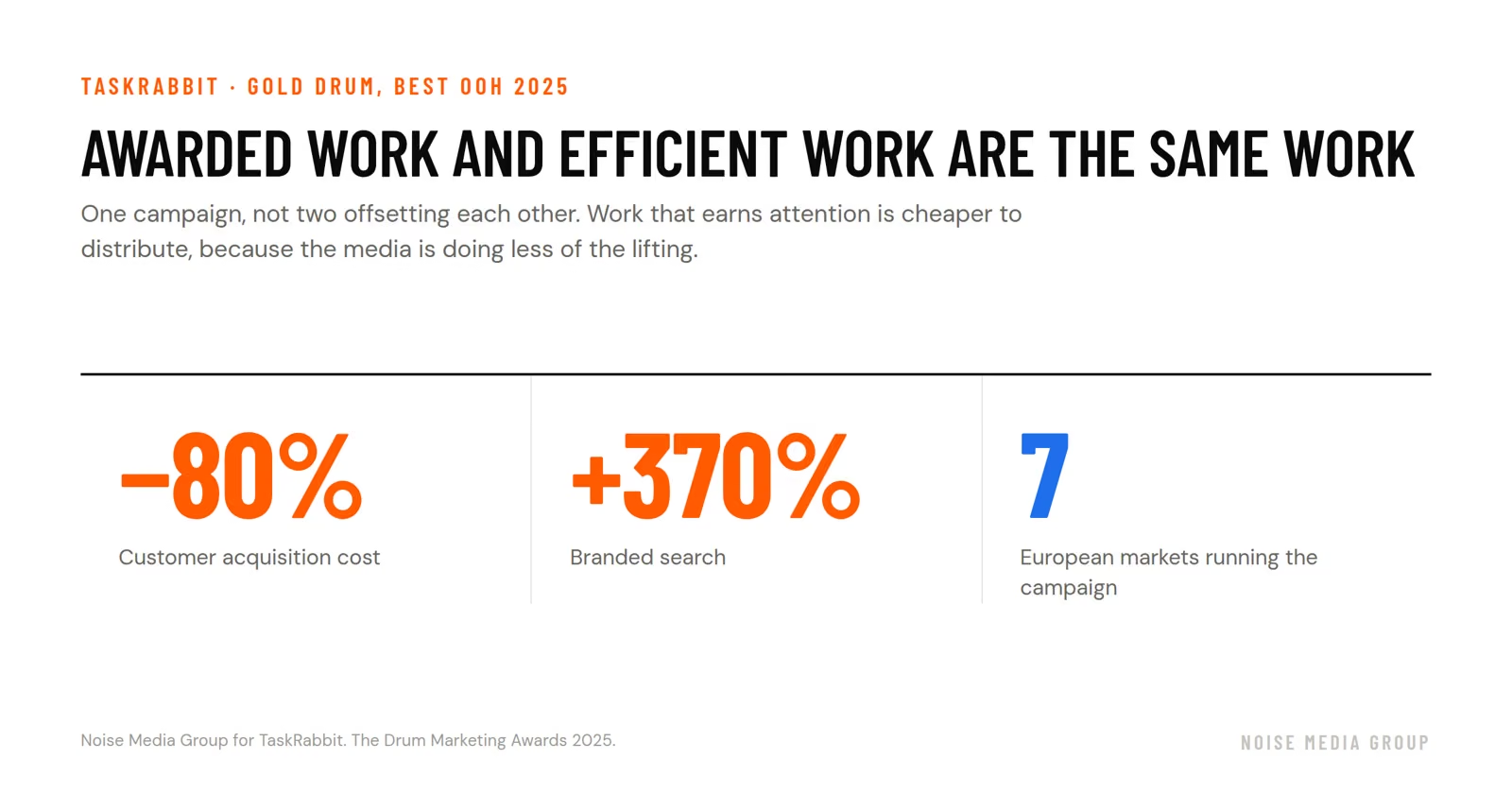
TaskRabbit is the clearest illustration. The starting point was a behavioural insight about what people photograph in public and why they bother posting it. Song lyrics, in-jokes, anything that makes the person sharing it look sharp for having spotted it. So the campaign became song-lyric parody OOH across London buses, billboards and tube stations, designed from the first sketch to be photographed rather than simply seen, with UGC social and retargeting conversion ads closing the loop against audiences the boards had already warmed. It scaled to seven markets on an 850% increase in ad spend, lifted branded search 370% and organic search 138%, generated thousands of organic social shares, and cut customer acquisition costs by 80%. That campaign is not buildable inside an agency where social sits downstream. The idea only exists if the social thinking happens before the media buy rather than after it.
Creative and paid media are built as one system
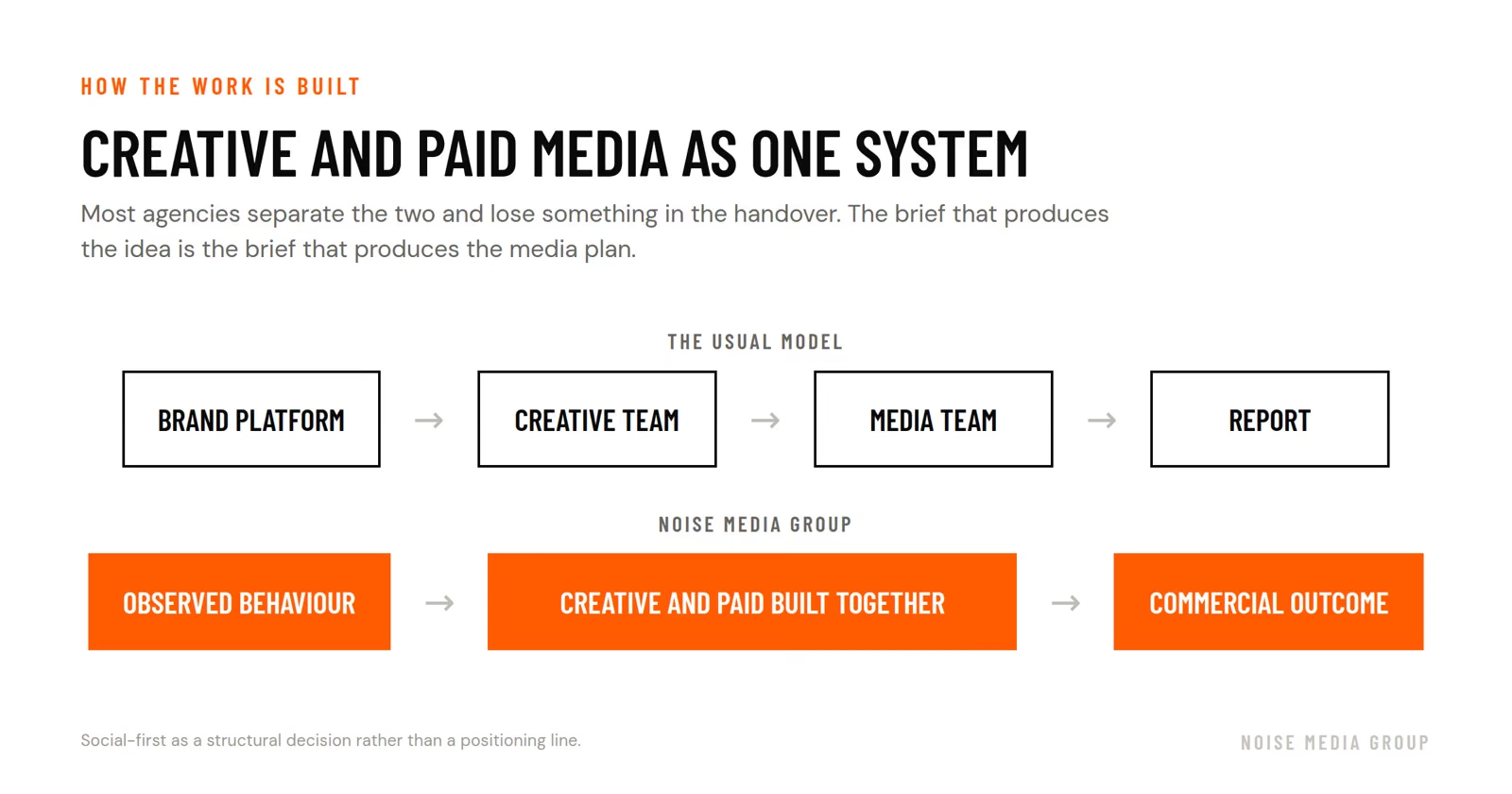
This is the structural difference that costs brands the most money and gets discussed the least. In the standard model, one team makes the work and a separate team spends the budget. They meet at handover. Creative optimises for the idea, media optimises for the auction, and neither has full sight of what the other is quietly trading away.
The consequences are concrete rather than theoretical. A creative decision taken in isolation, a two-second logo hold at the top of a video, a hero shot that only reads at desktop scale, sets a hard ceiling on performance that no amount of skilled buying will lift. It runs the other way too. Once the data shows which segment is converting, at what frequency, and where fatigue sets in, that should be rewriting the next creative brief within days rather than surfacing at a quarterly review.
Noise Media Group builds both from the brief stage, with the same people accountable for the same outcome. Creative sees the auction data. Media sees the edit before it is locked. The iteration loop runs in days, and the media budget stops subsidising creative that was never going to work.
Davines is the evidence. Their accounts had fragmented across European markets, with creative and buying decisions made separately in each one. The work unified them into a single strategy, rebuilt Meta and Google with proper retargeting layers, and paired UGC-led social with high-impact product page visuals produced against what the performance data was showing. The result was 67% more purchases on Meta without increasing ad spend, alongside 53% revenue growth across three European markets, a 50% increase in conversions on Google, and a 30% uplift in ROAS overall. Purchase growth without additional spend is only available to an agency where the two functions are talking daily.
Results are tied to business outcomes, not platform metrics
Reach and impressions are inputs. They confirm a media plan was executed and tell you nothing about whether the business is better off. Engagement rate is a marginally more useful input and still not an outcome. Noise Media Group reports on cost per acquisition, revenue, conversion volume and payback, and says so in the meeting when those move the wrong way rather than opening with a strong impressions slide.
This is not a philosophical preference, it changes what gets made. An agency accountable for CPA kills creative that generates comments and no carts. An agency accountable for reach has no reason to.
JustPark appointed the agency in June 2024 following a competitive pitch, and the work covered full-funnel paid across search, social and app alongside the brand's first-ever OOH campaign across London. Monthly conversions rose 68%, year-on-year revenue rose 60%, and CPA fell 52%. JustPark was subsequently acquired by US-based ParkHub, backed by LLR Partners and FTV Capital.
Jiffy followed a comparable arc. Their paid media was rebuilt into a multi-market performance engine, with UGC and trend-led social feeding click-to-book formats. PPC conversions rose 470%, Performance Max conversions rose 1,596%, social sign-ups grew 557%, social engagement rose 358%, and CPA fell 52%. Jiffy was acquired by Intact Financial Corporation. Neither acquisition is claimed as an agency achievement. What is claimed is narrower and more defensible: in both cases, the growth curve an acquirer was buying is one the agency was materially responsible for building.
What platform partner status actually means
Noise Media Group is a certified TikTok Marketing Partner, an accreditation awarded to agencies that meet TikTok's defined benchmarks for campaign performance, creative quality and spend management. The agency also holds Meta Business Partner and Google Partner status.
Badges on a website are worth very little in isolation, so it is worth being precise about what the status changes day to day. It provides named platform contacts rather than a support queue, which matters on the morning a campaign breaks at scale and a ticket response is forty-eight hours away. It provides access to new ad formats and beta placements ahead of general release, which is usually where the least competitive inventory sits for a short window before everyone arrives. And it provides verified benchmark data, so a claim that a 2.1% click-through rate is strong for a given category is measured against the platform's own vertical figures rather than against whichever client was run most recently.
The certifications also function as a floor rather than a ceiling. They are awarded against spend management and performance thresholds, which makes them a reasonable external check that an agency is not simply burning budget efficiently enough to look occupied. Any agency can be asked to evidence theirs, and any agency that hesitates is worth a second question.
Noise Media Group
See the difference first-hand.
A short conversation usually tells you more than a deck.

From structured testing to 170x ad spend
Noise Media Group has scaled brand ad spend by 170x. On its own that figure means very little, because scaling spend is the easiest thing in performance marketing. Scaling spend while holding efficiency is the difficult part, and it is a process rather than a knack.
The sequence is what matters. It starts small and structured, with deliberate tests across creative territory, audience and format, each given enough budget to reach significance and not a pound beyond it. Most of what gets tested fails, which is the intended outcome rather than a disappointing one. The next step is identifying which combinations hold efficiency as volume rises, because a great deal of creative performs at £500 a day and falls apart at £5,000. Only then does spend scale, and it scales into proven ground rather than being corrected after the fact. Jiffy's 170x growth in digital spend was that process running over roughly a year.
BrandYour shows the same discipline applied to a market entry. The brand was performing in the UK and wanted the US. Rather than lifting the UK campaign wholesale, the work ran seasonal creative built around American buying behaviour, iced cups through summer and coffee cups through winter, launching in New York with geo-targeted campaigns and proven creative before widening out. Year-on-year revenue rose 258%, CPA fell 32%, and social engagement rose 45%. New market entry usually costs two or three quarters of efficiency. It does not have to.
Creative ambition and performance are not a trade-off
There is a durable belief in the industry that brands must choose. Either an agency makes work that wins awards or work that sells things, and anyone claiming both is overselling one of them. That is a false choice, and more often a structural excuse than a creative truth. Work that earns attention is cheaper to distribute, because every major platform rewards content people actually watch and share with lower delivery costs. Ambition and efficiency point the same way far more often than the industry admits.
The TaskRabbit campaign won a Gold Drum Award for Best OOH Campaign at The Drum Marketing Awards 2025. The same campaign cut customer acquisition costs by 80% and lifted branded search 370%. Those are not two campaigns offsetting each other, they are one campaign doing both. A billboard built to be photographed generates distribution the media plan never paid for, and unpaid distribution is what makes the paid numbers look good.
Campaigns should earn attention and generate revenue. Work that manages one without the other is not finished.
Who Noise Media Group is right for, and who it is not
The agency works best with challenger brands, scale-ups and high-growth consumer businesses. More specifically, with businesses that need creative and performance to be a single conversation, that move quickly enough to act on what testing tells them, and that are prepared to treat social as the origin of the work rather than a line on a channel plan.
It is a poor fit in three situations, and naming them now is cheaper for everyone than discovering them in month four. Brands that need a conservative, low-variance approach where each campaign resembles the last will find the testing model uncomfortable, because a meaningful proportion of what runs is designed to fail and produce a finding. Brands that want creative held by one agency and media by another are asking the agency to work against the way it is built, and the main advantage disappears. And brands whose primary success measure is reach or impressions will spend the engagement disagreeing about the reporting, which helps nobody.
For anyone earlier in the process and still assembling a shortlist, the agency's separate guide to choosing a social media marketing agency in the UK sets out the questions worth putting to any agency, this one included. Noise Media Group works with clients as long-term partners and is always open to connecting prospective clients with existing ones. New business enquiries go to brands@noisemediagroup.co.uk.
Ready to make noise?
We're the agency challenger brands call when growth is non-negotiable.