How to Scale Paid Social Without Losing Performance (2026)

Scaling paid social without losing performance depends on three things being right before the budget increases: campaign structure consolidated so ad sets are not competing for the same impressions, creative production running at a cadence matched to spend level, and a measurement approach agreed in advance.
Performance drops at higher spend because each additional customer is bought deeper into the auction at a higher clearing price, not because paid social stops working. Fixing structure and creative supply first is what allows volume and efficiency to move in the same direction.
The pattern is consistent enough to be predictable. An account performs at £15k a month. Budget goes to £40k. CPA climbs, ROAS softens, and within six weeks someone senior is asking whether paid social has stopped working. Spend gets pulled back, performance recovers, and the account settles at a ceiling nobody chose.
The budget is almost never the problem. What breaks is the structure underneath it, the rate at which creative is produced, and the measurement being used to judge the whole thing. Those three failures compound, which is why scaling feels like a cliff rather than a gradient. This is a practical account of where accounts break at higher spend and what has to be true before budget goes up.
Struggling to scale paid social?
It's a structural problem. We've solved it for TaskRabbit, JustPark and others.

The real reason performance drops, and the three symptoms it produces
Start with the economics, because most explanations skip them. When you increase spend you are not buying more of the same customer. You are buying deeper into the auction, reaching people with progressively lower purchase intent at progressively higher clearing prices. The average customer you acquired at £15k a month is not the customer you acquire with the fortieth thousand pound. That marginal customer costs more, and eventually costs more than they are worth.
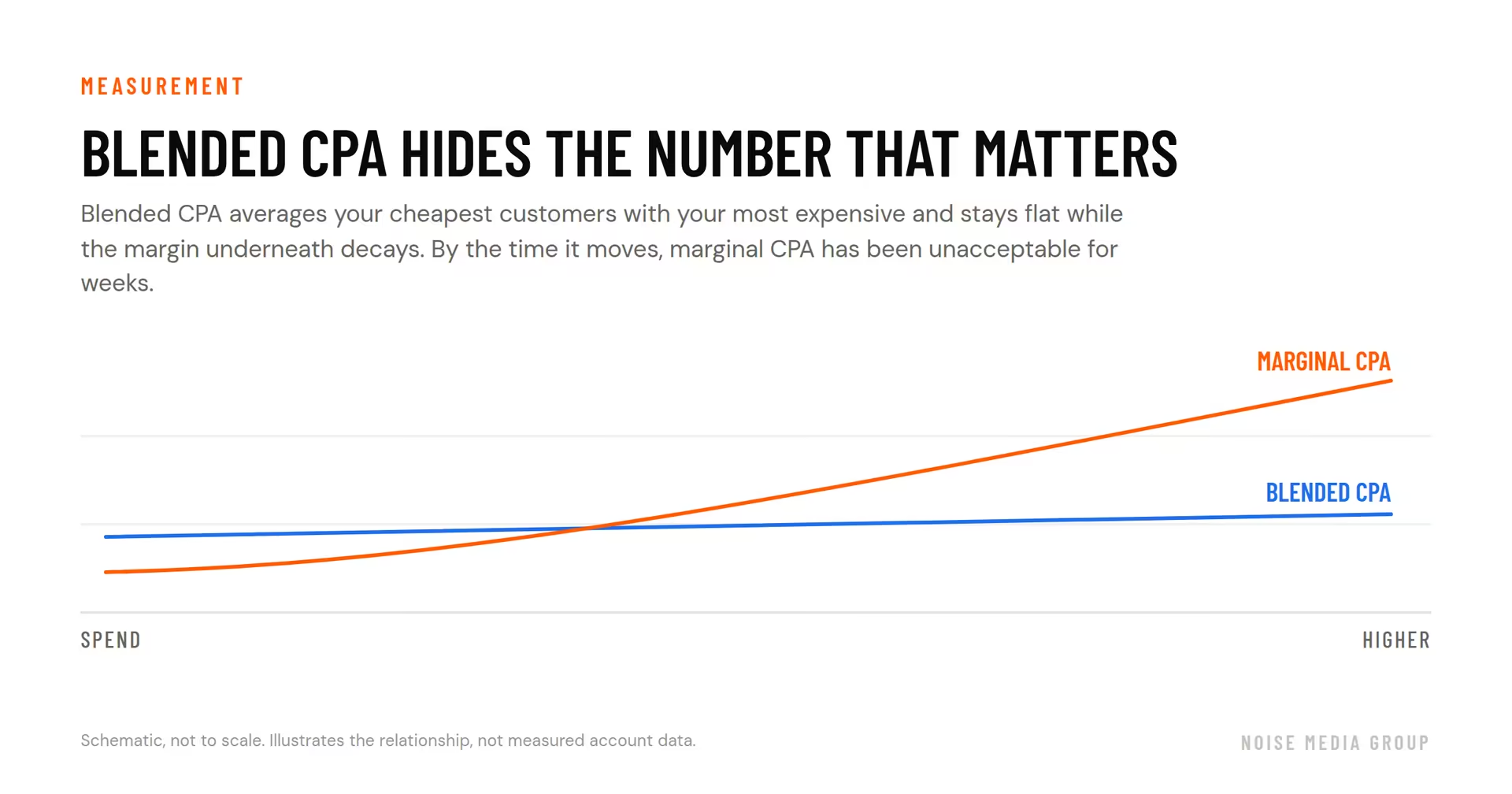
This is why blended CPA is a dangerous number to run an account on. It averages your cheapest customers together with your most expensive and reports a figure that stays flat while the margin underneath it decays. By the time blended CPA moves, marginal CPA has been unacceptable for weeks. The question worth asking is not "why did CPA rise" but "at what point does the next pound of spend stop paying for itself", and that requires looking at what incremental budget buys rather than what total budget averages.
Three mechanisms accelerate the decay. Audience saturation comes first: the same people seeing the same ads, with click-through falling as the pool exhausts. Creative fatigue follows, though not for the reason usually given, and the next section deals with it properly. Bidding strategy mismatch comes third, and it is the most underrated. A cost cap that held at £15k a month becomes a delivery brake at £40k, because the algorithm cannot find enough volume at that price and simply stops spending. A strategy tuned for efficiency at low volume will refuse to buy the volume you are now paying for.
None of this is inevitable. For JustPark, Noise Media Group's work drove a 68% increase in monthly conversions alongside a 52% decrease in CPA — volume and efficiency moving in the same direction rather than trading against each other. The relevant point is sequencing. That outcome came from getting structure and creative supply right before the budget went up. Scaling exposes weakness, it does not create it.
Structure that works at £15k breaks at £40k
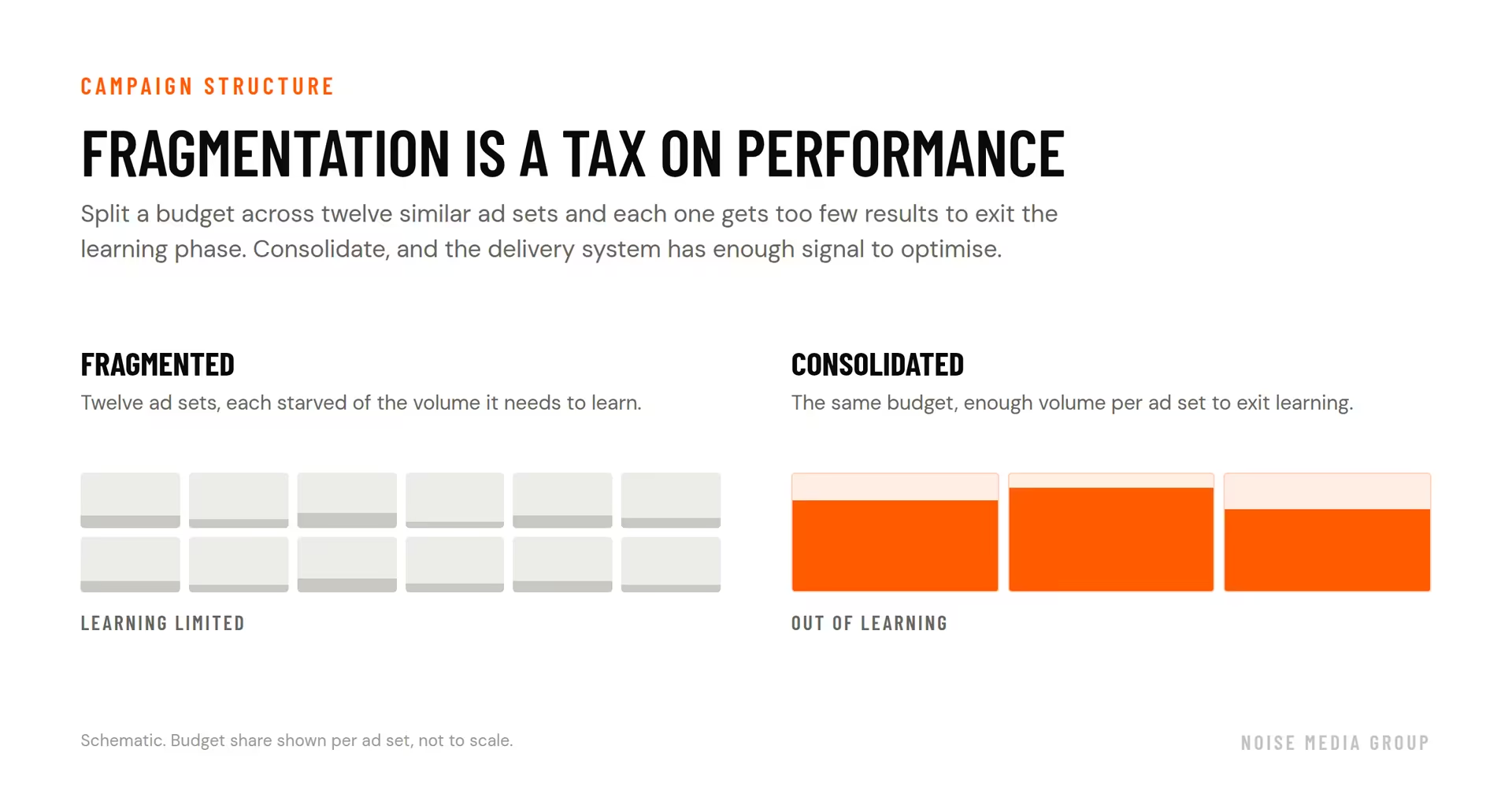
The most common structural error at scale is fragmentation, and it persists because it feels like control. More ad sets, tighter audiences, cleaner reporting. At higher spend it is a direct tax on performance.
Meta's auction mechanics explain part of the problem. For every available impression, Meta calculates a total value score using the advertiser bid, estimated action rate and ad quality, then delivers the eligible ad with the highest total value. The scaling issue is not that your ad sets literally bid against one another; it is that running similar ad sets at the same time gives each fewer opportunities to learn and fewer results. Consolidation concentrates those opportunities instead of fragmenting them.
That starvation has a specific consequence. During the learning phase, Meta's delivery system is still exploring how best to deliver an ad set, so performance is less stable and CPAs are usually worse. An ad set is marked learning limited when it has not generated enough results to exit. Fragment your budget across twelve similar ad sets and each gets fewer opportunities to learn; consolidating them gives the system more data and a better chance of stabilising.
This is also where the most persistent myth in paid social needs retiring. There is no published Meta rule that says increase budget by 20% every 72 hours. Meta confirms that significant edits can send an ad back into preparing and learning, but it does not publish a universal percentage threshold or cadence. Treat budget, targeting, creative and optimisation changes as interventions: make deliberate changes, allow the system to stabilise, and avoid turning an account into a sequence of overlapping tests.
Advantage+ campaign budget distributes spend between ad sets in real time to pursue the best available opportunities, so performance should be interpreted at campaign level rather than by expecting an even split. If ad sets differ significantly in audience size or opportunity, the distribution will not resemble a controlled, equal-budget test.
For Jiffy, Noise Media Group's work delivered a 470% increase in PPC conversions, a 1,596% increase in Performance Max conversions and a 52% lower CPA. The architecture came first and the results followed. Worth noting for anyone assessing those figures: a four-figure percentage from a small base is a different claim to the same percentage from an established account — a distinction covered in detail in the guide to what proven results actually mean.
Creative volume is the binding constraint on spend
Most accounts hit their ceiling here. Budget scales in a spreadsheet in an afternoon. Creative supply does not, and creative supply is what determines how much budget an account can absorb.
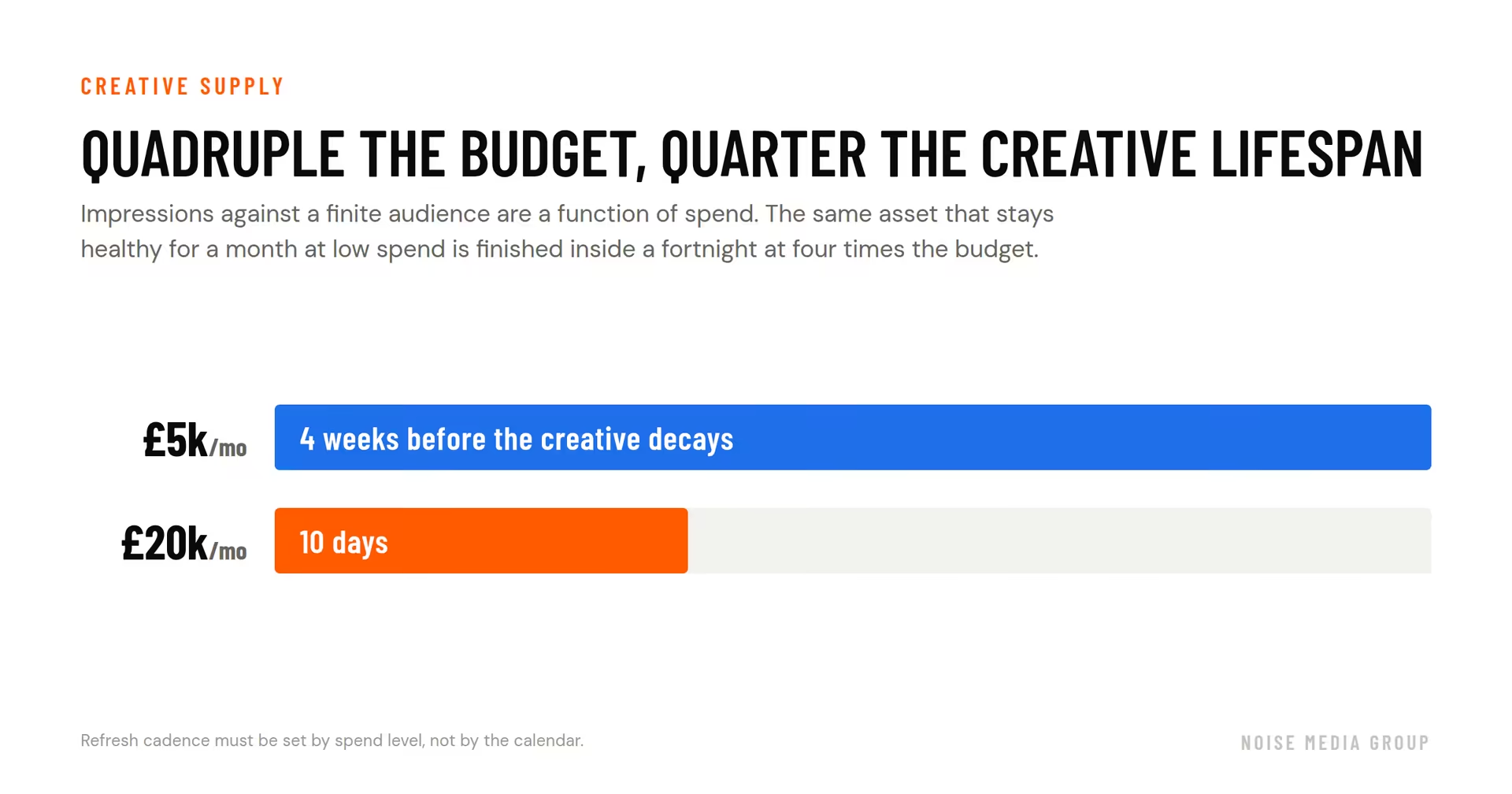
The mechanism is simple arithmetic. Impressions delivered against a finite audience are a function of spend, so quadrupling budget roughly quarters the time it takes to exhaust a creative against that audience. Something that stayed healthy for four weeks at £5k a month may be finished inside ten days at £20k. Teams that refresh monthly at low spend keep refreshing monthly at high spend and cannot work out why performance decays faster than it used to.
Drop the frequency thresholds while you are at it. Meta does not define creative fatigue by frequency, and has not for some time. It defines it against your own cost history: an ad is flagged creative limited when its cost per result exceeds that of your past ads, and fatigued when cost per result reaches twice that of past ads. That is a better diagnostic than any borrowed benchmark, because it is calibrated to your account rather than an industry average. The familiar "act at frequency five" convention traces to a single study of 500 campaigns published in 2018, which predates the tracking changes, the automation and the retrieval infrastructure that now govern delivery.
The practical answer is a production line rather than a reaction. Decide the refresh cadence from spend level and hold new variants in reserve before the current set decays, because anything briefed after the numbers move arrives four weeks too late. Creator and UGC content carries the volume load better than polished brand assets, partly because it costs less per asset and mostly because natural variation between creators produces genuine diversity rather than recolours of one idea. Brief the idea and the constraint rather than a locked script, and the variation arrives without being engineered.
In Noise Media Group's work with VOXI, creator-led UGC delivered a 124% higher click-through rate than standard formats, driving 175,000-plus students to site and 1,300 new customers. It worked because each execution felt different, not because each one was finished.
One structural note that catches people out. Meta's creative fatigue detection only runs on ad sets with a single creative, and is unavailable for dynamic creative and catalogue ads. At scale, most accounts are running exactly the setups the tool cannot diagnose, so the monitoring has to be yours.
Measurement breaks before performance does
At higher spend the gap between what the dashboard reports and what the business banks widens, and every scaling decision is made from that gap.
Start with what changed recently, because it caught a lot of accounts. In March 2026 Meta redefined click-through attribution so that only link clicks count, moving likes, shares, saves and comments into a separate engage-through bucket, and halving the qualifying video-view threshold from ten seconds to five. Advertisers may see reported click-through conversions change as the revised definition rolls out, even where spend and delivery remain unchanged. If your year-on-year comparison crosses that date, part of the decline you are looking at is definitional.
The strongest evidence against view-through attribution remains unanswered: when researchers ran placebo exposures against a control group, the control showed almost the same spike in brand searches and site visits as the treatment group. Being online and active causes both the impression and the conversion. Anything crediting an unclicked impression is largely measuring browsing intensity.
Last-click has the opposite failure. It over-credits whatever sits closest to purchase and under-credits everything that created the demand — precisely the upper-funnel activity you add when you scale. A 2023 study in Marketing Science analysed 663 randomised experiments at Meta using more than 5,000 user-level features and found that observational methods overstated lower-funnel effects by roughly thirteen times using propensity matching and roughly five times using state-of-the-art machine learning.
Geo holdouts are the practical route for most advertisers, because aggregating to market level removes the individual-level variance that makes user-level lift tests fail at anything below enormous spend. Meta's open-source GeoLift ships a function that outputs minimum detectable effect, required investment and test duration before you spend anything. Under-powered testing does not produce a cautious answer, it produces no answer at all.
Marketing mix modelling is the right answer at genuine scale and the wrong answer for most scale-ups. Gartner puts the viability threshold around $10m of programme and media budget, but the binding constraint is data rather than spend: Google's Meridian is designed around time-series media data, ideally broken out by geography, while Meta's Robyn recommends at least two years of weekly history. If you intend to model, build the variation into flighting on purpose.
Noise Media Group reports on conversions, CPA and revenue taken from the business rather than the platform dashboard. For JustPark that meant 60% year-on-year revenue growth and a 68% increase in monthly conversions — numbers that exist in the accounts rather than in Ads Manager.
Noise Media Group
Scaling paid social without losing efficiency.
It's a structural problem. We've solved it for TaskRabbit, JustPark and others.

New markets are a separate scaling problem
Budget scaling and geographic scaling get treated as one exercise and they behave differently. Adding a market resets everything the account has learned while inheriting none of the efficiency.
Media costs are the first surprise. Published benchmarks vary substantially by objective, audience and dataset. One UK-focused benchmark reports average CPMs of $10.85 in the UK and $20.48 in the US, while a separate US panel publishes different ranges for reach, traffic, lead-generation and sales campaigns. Treat the geographic direction as more reliable than any single absolute figure. Meta's Q1 2026 presentation reported average price per ad rising 19% year on year in Europe and 14% in the US and Canada — anyone planning expansion from older cost assumptions should reforecast using current account data.
Creative transfers worse than most teams expect, and the failure is rarely language. Platform mix differs, cultural reference points do not survive translation, and category conventions vary. The structural answer is separation. Ring-fence the new market in its own campaigns with its own budget so a launch cannot cannibalise a working account, produce localised creative rather than subtitled versions, and accept a deliberate learning period at known cost instead of discovering it in the blended number.
For BrandYour, Noise Media Group's work delivered a 258% year-on-year revenue increase and a 32% drop in CPA while scaling from the UK into New York. Separate structure, seasonal creative built for American buying behaviour, and a geo-targeted launch in one city before widening. Market entry usually costs two or three quarters of efficiency. Handled as its own project rather than an extension of the existing account, it does not have to.

What has to be true before you increase budget
Four things, all of which take longer to build than the budget takes to approve.
Proven creative: at least two or three ads with consistent positive performance across a meaningful period rather than one outlier that had a good fortnight. Extra budget applied to unproven creative buys reach for something that was never going to convert.
A consolidated structure with no internal competition, where ad sets are not starving each other of impressions and the bidding strategy suits the volume you are about to ask for rather than the volume you have.
An agreed measurement approach, settled before the budget moves. Decide now which number governs the decision, what the incrementality read will be, and what the marginal CPA ceiling is at which you stop. Agreeing that after performance has moved is how accounts end up arguing about attribution instead of fixing delivery.
A creative pipeline with a named cadence and assets already in production, because the refresh cycle shortens as spend rises and a pipeline commissioned in response to fatigue arrives after the damage.
If any one of those is missing, additional budget will find it faster than you can fix it. That is not an argument against scaling. It is the reason scaling looks effortless in some accounts and impossible in others.
FAQs
Why does paid social performance drop when you increase budget?
Because you are buying deeper into the auction, so each additional customer costs more than the average one you were getting before. Creative fatigue and audience saturation speed it up, but the underlying cause is diminishing marginal returns. Blended CPA hides it until the decay is already several weeks old.
How do you scale paid social without increasing CPA?
Fix the structure and the creative supply before the budget, not after. Consolidate ad sets so they are not starving each other of impressions, hold proven creative in reserve, and agree the measurement approach in advance. JustPark grew monthly conversions 68% while CPA fell 52%.
What is creative fatigue in paid social and how do you avoid it?
Meta defines it by cost rather than frequency: an ad is flagged as fatigued when its cost per result reaches twice that of your past ads. You avoid it by producing new creative on a fixed cadence instead of reacting once the number moves. At higher spend the same audience is exhausted faster, so the cycle has to shorten as budget rises.
How does Meta Advantage+ work at scale?
Advantage+ campaign budget sets one campaign-level budget and distributes it between ad sets in real time according to the best available opportunities. Read performance at campaign level and use ad-set minimums or maximums only when the brief genuinely requires tighter spending controls.
What is the right campaign structure for scaling paid social?
Use fewer ad sets, broader audiences and no more ads than you can keep supplied with useful conversion data. Similar ad sets running simultaneously each receive fewer opportunities to learn, so consolidation generally produces results and stable delivery faster.
How do you know when you are ready to scale paid social spend?
When you have two or three ads with consistent positive performance, a consolidated structure with no internal competition, an agreed measurement approach, and creative already in production for the next cycle. If one of those is missing, the extra budget will expose it within weeks. Scaling reveals weakness rather than creating it.
Ready to make noise?
We're the agency challenger brands call when growth is non-negotiable.